
Carly Williams and I founded the Habits for a Better World nonprofit almost two and a half years ago. We were talking about making some changes when one of our insightful members, Beth Keller Kirycki, said, “We’re no longer a scrappy startup! We need to scale up.” And she was right.
As a nonprofit, we’re not scaling up to generate more revenue. Instead, the project has grown so large and complex that we must take leadership, operations, and accountability as seriously as any for-profit organization. But scaling up brings both clear benefits and unique challenges for founders, which I’ll share below.
Having spent 36 years as an executive in a large multinational company, I know what scaling up requires. My first instinct was to hire a volunteer Chief of Staff, from my time as a Global Vice President before retiring, I knew the immense value of having a great CoS. So many exceptional people applied that after interviewing them, I decided to bring on three: Tina Tran as Chief of Staff; another who is a VP of HR in her day job, Samantha Koch, as Head of HR; and Dainiera (Dee) Kairaitis, who brings deep operations and IT experience, as Head of Operations.
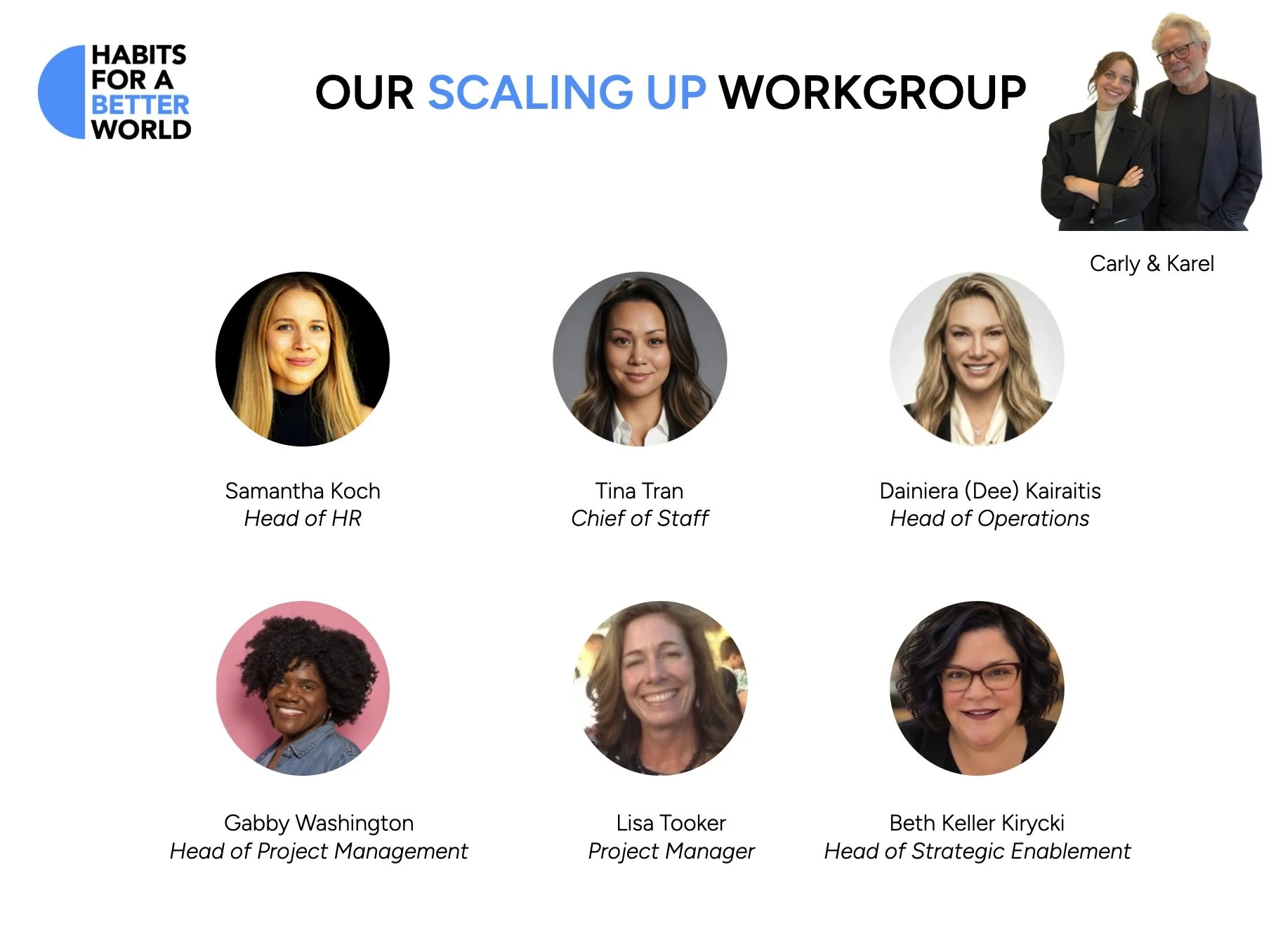
I brought them together with our Head of Project Management, Gabby Washington, PM Lisa Tooker, the member who inspired the scale up who is now Head of Strategic Enablement Beth Keller Kirycki, and Carly into a time-limited task force called the "Optimization Workgroup." We’ve been working together as a group for about six weeks now, and the progress has been extraordinary:
Sam built a structured recruiting and hiring process complete with a role requirements form and is already using it to bring on new volunteer leaders.
Tina created a volunteer code of conduct, an intake form for better team matching, and is working with us on an onboarding SOP.
Gabby led an audit of our current tooling stack, recommended key tool changes, with Lisa carried out a pilot test of one of the tools, and specified a new project management process.
Dee is leading the rollout of those new tools, migrating our teams, and handling access controls, privacy, and security.
Lisa analyzed our team’s skill mix and time-zone distribution to propose a reorganization that optimizes both.
Beth formed a team of discipline experts across marketing, content design, social media, and community collaboration to build playbooks and provide hands-on advice for continuous improvement.
We’re having an All-Hands call this Saturday with our full global membership that will go through the details of each of these topics, leaving plenty of time for Q&A and additional suggestions.
So What’s the Dilemma?
You might wonder how there could be a dilemma after seeing such incredible progress in just six weeks. I am, of course, delighted by how far we’ve come, the phenomenal skill and experience of this team, and how wonderful they are to work with.
It was actually a Substack post by our very own Beth that brought clarity to what I was feeling. Titled “Maybe dependence isn’t a design flaw,” her piece put words to an underlying tension I hadn't been able to articulate. Beth wrote about dependence in relation to health needs and her relationship with her husband. In my case, dealing with dependence had everything to do with the evolution of the nonprofit that was Carly's and my baby.
My entire career, my personal life, and my approach to running this nonprofit have been driven mostly by doing the work myself. Even in working with Carly, where we align closely on strategy, I’ve generally taken the lead on day-to-day execution.
To date, I’ve been the one recruiting, interviewing, onboarding, setting up access, running calls, sending updates, and reviewing progress. Suddenly, I have an amazing team of highly capable professionals doing all of that.
A clear example of this shift: Sam posted our recent leadership job ads and received 39 applicants. Automatically, my instinct was to dive in, but I couldn't immediately see the applicant details, resumes, or portfolios. It forced me to get comfortable being dependent on others. While I have absolute trust in Sam and the team, it still requires a real psychological adjustment.
The paradox is that I’ve said for a long time that I wanted to step back from administrative operations. Letting go frees me up to focus on the substantive content our teams produce, including the feature documentary Carly and I are building, as well as my expanded responsibilities as an Industry Professor.
All of this is positive, but I am intentionally reflecting on the founder’s journey of learning to take my hands off the reins. Transitioning from doing to trusting takes time, and that's the real dilemma of scaling up.
